
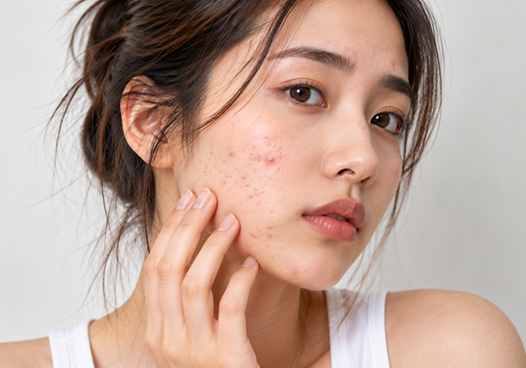
If you have acne, you’ve probably received plenty of advice.
“Wash your face more.”
“Stop eating chocolate.”
“Your skin is too oily—you need to dry it out.”
“Protein powder causes acne.”
“Just pop the pimple.”
Some of these ideas contain a tiny bit of truth. Others are outdated. And some can actually make your skin worse.
So instead of another complicated acne routine, let’s start our acne series by answering a simpler question:
What’s actually true?
MYTH #1: Acne Means Your Face Is Dirty
Acne is not caused by poor hygiene.
Acne actually starts inside the hair follicle, where several things can happen at the same time:
- your skin produces more sebum (oil)
- dead skin cells build up and clog the follicle
- Cutibacterium acnes (C. acnes) contributes to changes inside the follicle
- inflammation develops
That’s why washing your face five times a day won’t necessarily clear your acne.
In fact, aggressive scrubbing and over-cleansing can irritate your skin and make it harder to tolerate acne treatments.
The takeaway: Keep your skin clean, but don’t try to scrub your acne away.
MYTH #2: Oily Skin Needs to Be Dried Out
This one sounds logical.
Acne-prone skin often produces more sebum, so shouldn’t you remove as much oil as possible?
Not quite.
Sebum is a normal part of your skin barrier. Excess sebum can contribute to acne, but stripping your skin with harsh cleansers, excessive exfoliation or drying products doesn’t necessarily address why your sebaceous glands are producing more oil.
Hormones—particularly androgens—play an important role in stimulating sebum production.
That’s why some acne treatments actually target the hormonal pathway or sebaceous glands rather than simply drying the surface of your skin.
The takeaway: Oil control can help, but extremely dry skin isn’t the goal.
MYTH #3: Acne Is Just a Bacterial Infection
You’ve probably heard that acne is caused by bacteria.
That’s only part of the story.
C. acnes is naturally found on healthy skin. Acne develops through a much more complicated interaction between sebum, clogged follicles, microorganisms and inflammation.
This helps explain why an antibacterial treatment alone may not solve everyone’s acne.
Different medications target different parts of the acne cycle:
Retinoids → help prevent clogged follicles
Benzoyl peroxide → reduces C. acnes
Hormonal treatments → can influence androgen-driven pathways
Anti-inflammatory treatments → help calm inflammation
This is also why modern acne guidelines recommend combining treatments with different mechanisms of action when appropriate. Single long term topical antibiotics treatment is not recommended.
The takeaway: Acne isn’t simply an infection. It has multiple causes.
MYTH #4: Protein Powder Causes Acne
This one gets especially interesting if you go to the gym.
When people say “protein powder causes acne” they’re usually talking about whey protein, which comes from milk.
There have been reports and observational studies linking whey protein supplements with acne.
For example, a 2024 study involving 201 male teenagers and young adults found that 47% of participants with acne reported whey protein use compared with 27.7% of participants without acne. That showed an association—but it couldn’t prove that whey actually caused their acne.
Then researchers put the question to a stronger test.
A 2024 double-blind randomized controlled trial followed 49 young men with mild-to-moderate acne for six months. One group consumed 30 g of whey protein daily, while the other received a non-whey supplement.
Surprisingly, the whey group did not experience worse acne than the non-whey group.
So what’s the answer?
At the moment, the evidence is mixed.
The latest American Academy of Dermatology acne guideline concluded that there isn’t enough evidence to recommend a low-whey diet as an acne treatment.
That doesn’t mean your own experience doesn’t matter.
If you consistently notice your acne worsening after starting a whey protein supplement, tell your healthcare provider and consider whether a monitored change makes sense. But we shouldn’t tell everyone with acne that they need to stop protein powder.
And importantly, “protein powder” and “whey protein” aren’t interchangeable terms. Protein supplements can come from many different sources.
The takeaway: Whey protein might affect acne in some people, but current research hasn’t established that whey causes acne for everyone.
MYTH #5: Chocolate Causes Pimples
Your chocolate bar probably doesn’t create a pimple overnight.
But diet and acne aren’t completely unrelated either.
Research has increasingly looked at high-glycemic diets—foods that cause blood sugar to rise quickly.
Higher insulin and insulin-like growth factor-1 (IGF-1) signaling may influence pathways involved in sebum production and acne development.
Some controlled studies have found improvement in acne with lower-glycemic diets, while others haven’t found a significant difference.
So rather than blaming one chocolate bar, it’s more useful to look at the overall dietary pattern.
The takeaway: The relationship between food and acne is more complicated than “chocolate = pimples.”
MYTH #6: Dairy Definitely Causes Acne
Dairy is another controversial one.
Several observational studies have found an association between cow’s milk consumption and acne, with skim milk appearing repeatedly in the research. But association doesn’t prove that milk directly causes acne. American Academy of Dermatology
There are also many people who consume dairy without developing acne.
Current evidence isn’t strong enough to tell everyone with acne to eliminate dairy from their diet.
The takeaway: If you suspect a dietary trigger, look for a consistent pattern and discuss it with an appropriate healthcare professional.
MYTH #7: The More Acne Ingredients I Use, the Faster My Skin Will Clear
This is an easy trap to fall into.
You start with salicylic acid.
Then add benzoyl peroxide.
Then a retinoid.
Then an exfoliating toner.
Then an AHA serum.
Then another “acne treatment.”
Before long, your skin is burning, peeling and bright red.
More irritation does not mean more effectiveness.
Acne treatments can work very well in combination—but they should be combined strategically.
For example, a retinoid and clindamycin target different acne pathways. That’s very different from randomly stacking several exfoliating products on top of one another.
The takeaway: Treat different acne mechanisms—not your skin with every active ingredient you can find.
MYTH #8: You Should Only Treat Pimples When They Appear
By the time you can see a pimple, the process that created it has already started.
The earliest acne lesion is called a micro-comedone, a microscopic blockage inside the follicle.
You can’t see it yet.
That’s why medications such as topical retinoids are generally used across acne-prone areas, rather than being dabbed only onto the pimples you can already see.
Think of acne treatment as prevention + treatment, not simply emergency pimple control.
The takeaway: Don’t just treat today’s pimple. A good acne routine should help prevent tomorrow’s.
MYTH #9: Popping a Pimple Makes It Heal Faster
We know. It’s tempting.
But squeezing an inflamed pimple can cause additional trauma and inflammation.
And once inflammation goes deeper into the skin, you increase your chances of being left with something that lasts much longer than the pimple itself: post-inflammatory hyperpigmentation or potentially a scar.
This is particularly important if your skin tends to develop dark marks after acne.
The takeaway: That pimple may last several days. The mark you create by picking at it can last much longer.
MYTH #10: If My Acne Treatment Isn’t Working After Two Weeks, I Need Something Stronger
Acne treatment takes time.
You aren’t only treating the pimples you see today. You’re trying to change what’s happening inside acne-prone follicles and prevent new lesions from forming.
Switching products every week or two can make it difficult to know whether anything actually works and constantly introducing new ingredients can create unnecessary irritation.
If your treatment isn’t working after an appropriate trial, or your acne is painful, worsening, leaving scars or significantly affecting you, that’s when it’s worth getting professional help.
So What Actually Works?
If there’s one thing to remember from all these myths, it’s this:
Acne doesn’t have one single cause.
Oil production, clogged follicles, C. acnes, hormones and inflammation can all play a role.
That’s why the best treatment isn’t necessarily the strongest product or the longest skincare routine.
It’s about figuring out which acne pathways need to be addressed and choosing treatments that target them without unnecessarily irritating your skin.
In our next acne article, we’ll break down the major acne treatments—from retinoids and benzoyl peroxide to azelaic acid and hormonal treatments and explain what each ingredient actually does inside your skin.
References
- Reynolds RV, Yeung H, Cheng CE, et al. Guidelines of care for the management of acne vulgaris. J Am Acad Dermatol. 2024;90(5):1006.e1–1006.e30. https://www.jaad.org/article/S0190-9622(23)03389-3/fulltext
- Meixiong J, Ricco C, Vasavda C, Ho BK. Diet and acne: A systematic review. JAAD Int. 2022;7:95–112. https://www.jaadinternational.org/article/S2666-3287(22)00028-1/fulltext
- Sompochpruetikul P, et al. Whey protein and male acne: A double-blind, randomized controlled trial. J Dermatol. 2024. PMID: 38291989. https://pubmed.ncbi.nlm.nih.gov/38291989/
- Albalat W, et al. The Effect of Whey Protein Supplements on Acne Vulgaris among Male Adolescents and Young Adults: A Case-Control Study from North of Jordan. Dermatol Res Pract. 2024. https://pubmed.ncbi.nlm.nih.gov/38633058/