
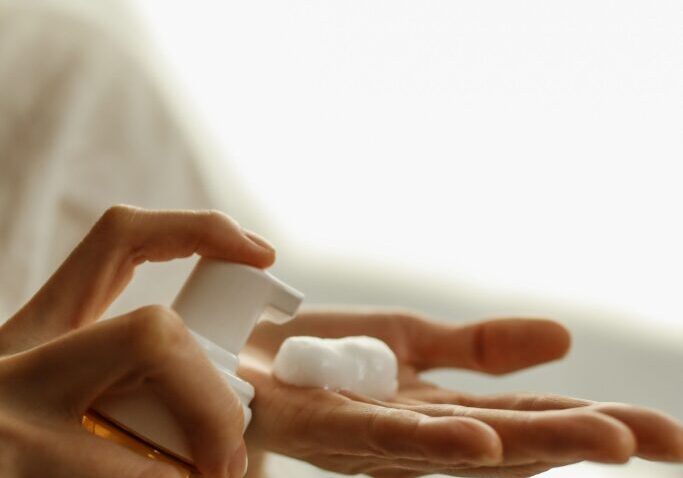
“Why does my topical hair solution make my scalp so dry and itchy?”
“My hair feels greasy and sticky after I apply it. Is there a less messy option?”
“I’ve heard propylene glycol can irritate the scalp. Can my formula be made without it?”
“Should I use a foam or a liquid—and does changing the base affect how well my medication works?”
“I have a sensitive scalp. Is there an alcohol-free option?”
These are questions we commonly hear when patients use topical hair formulations and they’re also questions frequently discussed by people using topical minoxidil and finasteride.
When we talk about a customized topical hair formulation, most people naturally focus on the active ingredients: How much minoxidil does it contain? Should finasteride be added? What concentration should I use?
But there is another part of the formulation that deserves just as much attention:
THE BASE
The base, also called the vehicle, carries the active ingredients and allows them to be applied across the scalp. And when you’re applying a medication every day, the vehicle can make a surprisingly big difference.
It can affect how quickly the solution dries, whether your hair feels greasy or sticky, whether your scalp becomes dry or irritated, and ultimately how comfortable it is to use the formulation consistently.
At Atria, we currently offer four main vehicle options for personalized topical hair formulations: an alcohol-based solution, an AnaGain™ formulated foam, an alcohol-free TrichoSol™ solution, a liposomal gel.
What’s actually different about them and which one might suit you better? Let’s dive into it!
Option 1: Alcohol-Based Solution
Alcohol-based solutions are one of the most familiar vehicles for topical hair medications.
Alcohol serves an important pharmaceutical purpose: it can help dissolve certain active ingredients, facilitates application across the scalp, and evaporates relatively quickly after application.
But did you know that not all alcohols are the same?
Ethyl Alcohol vs Isopropyl Alcohol
“Alcohol” on an ingredient list can refer to several different substances.
Two common examples are:
- Ethanol, also called ethyl alcohol
- Isopropanol, also called isopropyl alcohol
Although both are alcohols, their effects on skin are not necessarily identical.
One experimental study comparing ethanol, isopropanol and n-propanol found that ethanol was the best tolerated by the skin and produced the mildest effects on several measures of irritation. Isopropanol caused more irritation, while n-propanol was the least well tolerated of the three. In simple terms, the study found the following order from most to least irritating: n-propanol → isopropanol → ethanol.
At Atria, our alcohol-based hair solution is prepared using USP-grade ethyl alcohol (ethanol).
What Does “USP Grade” Mean?
USP stands for United States Pharmacopeia. (For more information about USP grade vs cosmetic grade, you can learn more in our previous blog https://www.atriapharmacy.com/pharmaceutical-grade-skincare/)
When an ingredient meets USP specifications, it has to meet established pharmaceutical quality standards for factors such as identity, purity and allowable impurities.
This doesn’t mean that USP-grade ethanol cannot cause dryness or irritation. Rather, it means we are using ethanol that meets a recognized pharmaceutical quality standard rather than an unspecified industrial or technical-grade alcohol. As unspecified grade alcohol can contain impurities that cause skin irritation.
Advantages of an Alcohol-Based Solution
For many patients, the biggest advantage is the cosmetic feel.
It spreads easily through the scalp, dries relatively quickly and generally leaves less residue in the hair than heavier vehicles.
Alcohol can also be useful as a solvent for active ingredients that may otherwise be difficult to incorporate into a topical solution.
What Are the Downsides?
Higher concentrations of alcohol can be drying for some people, particularly with repeated application.
Some traditional topical minoxidil solutions also contain propylene glycol, which can contribute to irritation or allergic contact dermatitis in susceptible patients. Published reports have documented patients reacting to the propylene glycol vehicle rather than minoxidil itself.
For someone with a dry, sensitive or easily irritated scalp, a lower-alcohol or alcohol-free option may therefore be worth considering.
Option 2: AnaGain™ Formulated Foam
For patients who don’t want a conventional alcohol solution but still want something relatively easy to distribute through the scalp, a foam base can offer a middle ground.
At Atria, our foam vehicle contains less than 10% alcohol, substantially reducing the alcohol content compared with many traditional hydro-alcoholic solutions.
Reduced-alcohol, propylene-glycol-free foam vehicles have specifically been developed for topical minoxidil compounding to address some of the irritation associated with vehicles containing higher amounts of alcohol and propylene glycol.
An Added Ingredient: AnaGain™
Our foam formulation also incorporates AnaGain™, a cosmetic hair-care ingredient derived from Pisum sativum (pea) sprout extract.
There is emerging research on hair serums containing AnaGain in combination with other cosmetic hair ingredients. However, the available clinical evidence is much more limited than the evidence supporting established medications such as minoxidil or finasteride. For that reason, I would describe AnaGain as a supportive hair-care ingredient, rather than suggesting that it independently treats hair loss.
Advantages of the Foam Base
The foam offers lower alcohol exposure, which may be preferable for patients who find a traditional alcohol solution too drying.
The foam format can also make it easier to apply a measured amount directly to the scalp.
What Are the Downsides?
The biggest difference our patients may notice is the texture.
Our foam can feel slightly stickier than the alcohol-based solution, and some patients may notice more product in their hair after application.
For someone whose highest priority is a very light, fast-drying feel, a solution may still be preferable.
Option 3: TrichoSol™ — An Alcohol-Free Solution
Our newest option is TrichoSol™, an innovative hydrophilic solution base specifically designed for topical scalp formulations.
The major difference?
It is alcohol-free and propylene glycol-free.
That makes it an interesting option for patients who have previously experienced dryness, itching or sensitivity with conventional alcohol- or propylene-glycol-containing solutions.
TrichoSol is also described by its manufacturer as hypoallergenic and non-comedogenic and is designed to incorporate a range of active pharmaceutical ingredients used on the scalp.
And There’s One Small Difference You May Notice…
The smell.
Anyone who has used a topical hair formulation every day knows that smell matters more than you might expect.
From our own experience working with the base at Atria, TrichoSol has a relatively herbal and botanical pleasant scent compared with our other topical hair vehicles.
That’s not necessarily a clinical advantage—but when you’re applying something to your scalp every day, the experience matters too.
What Are the Downsides?
The main considerations with TrichoSol are cosmetic texture and cost.
TrichoSol is a water- and glycerin-based vehicle rather than a conventional alcohol-based solution, it may take longer to dry and can leave the hair feeling wetter, slightly heavier, or stickier after application. Patients who prioritize a very light, fast-drying finish may prefer an alcohol-based solution.
TrichoSol is also a premium specialty compounding base, so formulations prepared with it may cost more than those made with a conventional alcohol-based vehicle.
Option 4: Liposomal Gel — More Targeted Application
For some patients, the biggest challenge with a topical hair solution isn’t irritation—it’s getting the medication onto the scalp without having it run or spread into the surrounding hair.
A gel base has a thicker consistency, allowing it to stay more readily where it is applied. This can make it particularly useful for targeted areas such as the hairline, temples, or localized areas of thinning.
What Is a Liposomal Gel?
Our gel base contains liposomes, which are tiny lipid-based vesicles that can be used as delivery systems for active ingredients.
Because their structure is composed of lipid bilayers, liposomes can help encapsulate certain active ingredients and facilitate their delivery into the skin. In topical pharmaceutical formulations, liposomal delivery systems have been studied as a way to modify drug penetration, improve localization within the skin, and potentially reduce unnecessary systemic exposure depending on the drug and formulation.
For a topical hair formulation, this gives the gel an additional pharmaceutical advantage beyond simply making the product thicker.
However, liposomal delivery doesn’t automatically mean better clinical results. How an active ingredient behaves depends on the medication, concentration, liposome composition and overall formulation.
Why Might Someone Choose the Liposomal Gel?
The gel may be worth considering if you:
- want more control over exactly where the formulation is applied;
- are treating smaller areas such as the temples or hairline;
- prefer a formulation that doesn’t run as easily as a liquid; or
- are interested in a liposomal delivery vehicle for compatible active ingredients.
What Are the Downsides?
Because it is thicker, gel may be more noticeable in the hair and may not distribute as easily over a large area of the scalp.
Some patients may also find a gel slightly tackier or heavier than a fast-drying alcohol solution.
| Alcohol-Based Solution | AnaGain™ Formulated Foam | TrichoSol™ Solution | Liposomal Gel | |
|---|---|---|---|---|
| Texture | Thin liquid | Foam | Hydrophilic liquid | Gel |
| Drying/feel | Light, fast drying | Slightly stickier | Slower drying; may feel wetter/heavier | May feel tackier in hair |
| Alcohol | Yes | <10% | Alcohol-free | <10% |
| Propylene glycol | Usually contains | Propylene glycol-free | Propylene glycol-free | Yes |
| Main advantage | Fast drying, minimal residue | Reduced alcohol + foam application | Alcohol- and PG-free; sensitive-scalp option | Targeted application + liposomal delivery |
| Additional feature | USP-grade ethyl alcohol | Can incorporate AnaGain™ | Pleasant scent | Contains liposomes |
| Potential downside | Can be drying for sensitive scalps | Can feel stickier | Slower drying and may feel wetter/heavier; higher cost | May notice product pilling especially when formulations are packed with multi ingredients |
| May suit someone who… | Prioritizes fast drying | Wants less alcohol and prefers foam | Is sensitive to alcohol or PG | Wants precise application to localized areas |
The Base Is Part of Personalizing Your Hair Formulation
There isn’t one hair-loss base that is automatically best for everyone.
Someone with an oily scalp who wants the fastest-drying formulation may prefer an alcohol-based solution.
Someone who wants to reduce alcohol exposure while retaining a foam application may prefer the reduced-alcohol foam.
And someone who has struggled with alcohol or propylene glycol sensitivity may want to discuss an alcohol-free TrichoSol formulation.
But personal preference isn’t the only consideration. The prescribed active ingredients, concentrations, solubility and stability also determine which vehicles are appropriate.
At Atria Compounding Pharmacy, our compounding pharmacists can review your prescribed hair formulation along with your scalp sensitivity, preferred texture, application method and personal preferences to help determine which compatible base may be most suitable for you.
Because personalizing a topical hair formulation isn’t only about choosing the active ingredients—it’s also about finding a formulation you can comfortably use as directed.
References
- Cartner T, Brand N, Tian K, et al. Effect of different alcohols on stratum corneum kallikrein 5 and phospholipase A2 together with epidermal keratinocytes and skin irritation. Int J Cosmet Sci. 2017;39(2):188–196. https://pubmed.ncbi.nlm.nih.gov/27578266/
- Sidhu RS, et al. Stability Evaluation of Minoxidil in FOAMIL Foam Base with Bracketing Study Design. Int J Pharm Compd. 2021. https://pubmed.ncbi.nlm.nih.gov/34125714/
- Friedman ES, Friedman PM, Cohen DE, Washenik K. Allergic contact dermatitis to topical minoxidil solution: etiology and treatment. J Am Acad Dermatol. 2002;46(2):309–312. https://pubmed.ncbi.nlm.nih.gov/11807448/
- TrichoSol™ Hydrophilic Solution Base. Fagron. https://fagron.us/bases/product/trichosol