

Have you ever looked in the mirror and felt like your skin suddenly changed almost overnight?
Perhaps it feels thinner, drier, less firm, or has simply lost its natural glow.
Understanding the Role of Hormones in Healthy, Youthful Skin
For many women, these changes become more noticeable during perimenopause and menopause. While aging is a natural process, one important factor is often overlooked—the decline in estrogen levels.
Most people associate estrogen with reproductive health, but it also plays a remarkable role in maintaining healthy skin. As estrogen levels fall, the skin undergoes several biological changes that contribute to visible signs of aging.
Let’s explore what the science tells us.
How Estrogen Supports Healthy Skin
Our skin contains estrogen receptors in both the epidermis (outer layer) and dermis (deeper layer), allowing estrogen to influence many aspects of skin health.
Healthy estrogen levels help support:
- Collagen production
- Skin elasticity
- Moisture retention
- Skin thickness
- Wound healing
- Skin barrier function
These effects work together to keep skin looking firmer, smoother, and better hydrated.
What Happens When Estrogen Declines?
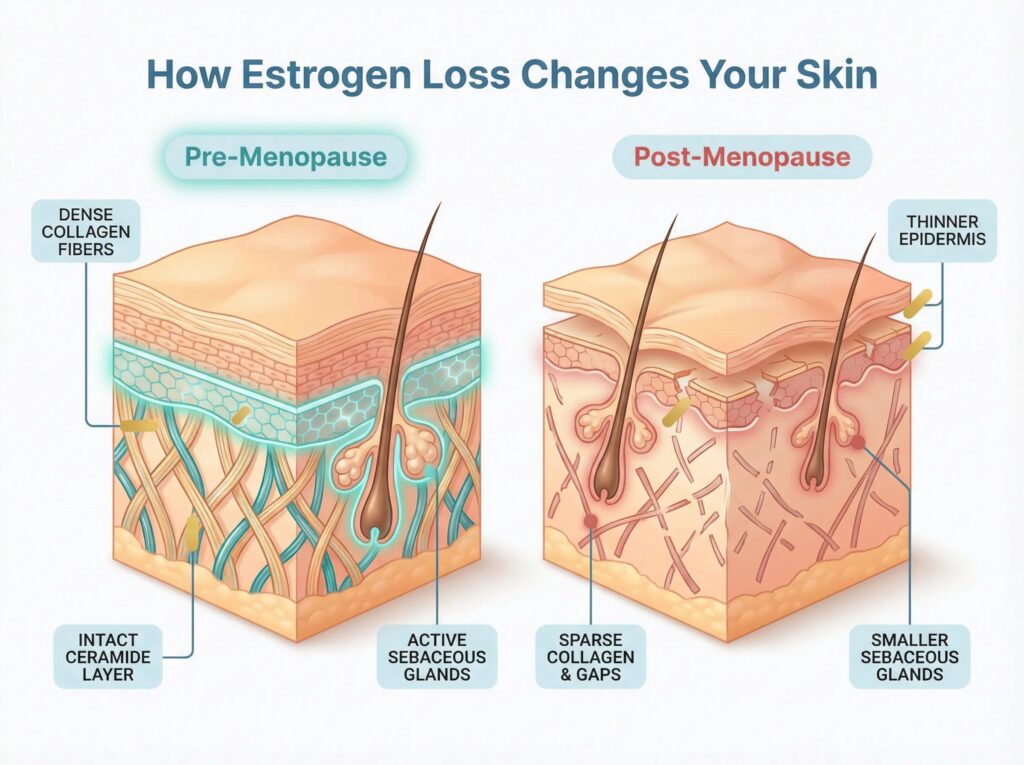
During menopause, estrogen production decreases significantly. This hormonal shift affects much more than reproductive health—it also changes the structure and function of the skin.
Women commonly notice:
- Increased dryness
- Fine lines and wrinkles
- Thinner, more fragile skin
- Reduced firmness
- Slower wound healing
- Loss of skin “bounce”
These changes are collectively referred to as estrogen-related skin aging.
Why Does Collagen Decline So Quickly?
Collagen is the structural protein that gives skin its strength and firmness.
Research has shown that women may lose up to 30% of their skin collagen during the first five years after menopause, followed by an ongoing decline of approximately 2% each year thereafter. This reduction contributes to thinner skin, decreased elasticity, and the gradual development of wrinkles.
Estrogen helps regulate fibroblasts—the cells responsible for producing collagen and elastin. As estrogen levels fall, collagen production slows while existing collagen continues to break down as part of the normal aging process.
Why Does Mature Skin Feel So Dry?
Many women say that after menopause, their skincare products “just don’t work like they used to.”
One reason is that estrogen helps maintain the skin’s natural moisture balance.
Lower estrogen levels are associated with:
- Reduced production of natural lipids
- Increased transepidermal water loss (TEWL)
- Slower skin barrier repair
- Decreased skin hydration
The result is skin that often feels tighter, rougher, and more sensitive than before.
Looking Ahead
Understanding how estrogen influences the skin is the first step toward understanding why skin changes so noticeably during menopause.
The good news is that researchers have spent decades studying ways to support skin health during this stage of life. Alongside healthy lifestyle habits, sun protection, and evidence-based skincare, scientists have explored whether topical estrogen therapies—particularly estriol—may help address some of the structural changes associated with declining estrogen levels.
So, what does the research actually say?
Can topical estriol improve skin hydration, elasticity, and collagen? How does it compare with traditional anti-aging ingredients? And is it appropriate for everyone?
We’ll explore these questions in our next article, where we take a closer look at the clinical evidence behind topical estriol and skin health.
Continue reading → Can Topical Estrogen Cream Improve Skin Health? What the Clinical Studies Show
References
- Brincat MP. Hormone replacement therapy and the skin. Maturitas. 2000;35(2):107–117.
https://pubmed.ncbi.nlm.nih.gov/10915911/ - Thornton MJ. Estrogens and aging skin. Dermato-Endocrinology. 2013;5(2):264–270.
https://pmc.ncbi.nlm.nih.gov/articles/PMC3772914/ - Schmidt JB, Binder M, Demschik G, et al. Treatment of skin aging with topical estrogens. International Journal of Dermatology. 1996;35(9):669–674.
https://pubmed.ncbi.nlm.nih.gov/8876303/