
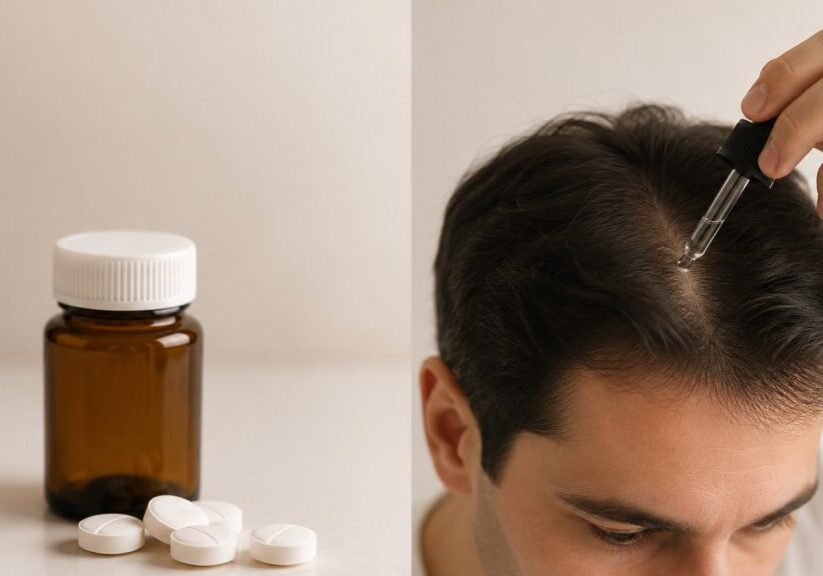
For many men experiencing hair loss, finasteride is one of the most well-studied medications available for treating androgenetic alopecia (male pattern hair loss). Traditionally taken as an oral tablet, finasteride works by lowering levels of dihydrotestosterone (DHT)—the hormone primarily responsible for shrinking genetically susceptible hair follicles.
In recent years, topical finasteride has gained increasing attention as an alternative approach. By applying the medication directly to the scalp, researchers hope to target hair follicles while reducing the amount of medication reaching the bloodstream.
So which option is right for you? This article reviews the current scientific evidence, explains the differences between oral and topical finasteride, and discusses how personalized topical formulations may fit into an individualized hair loss treatment plan.
What Causes Male Pattern Hair Loss?
Male pattern hair loss, also known as androgenetic alopecia, is largely influenced by genetics and the hormone dihydrotestosterone (DHT).
Over time, DHT binds to androgen receptors within genetically susceptible hair follicles. This gradually causes follicles to become smaller—a process known as miniaturization—resulting in shorter, finer hairs and eventually reduced hair density.
Finasteride works by inhibiting the enzyme 5-alpha reductase type II, reducing the conversion of testosterone into DHT.
How Does Oral Finasteride Work?
The effectiveness of oral finasteride has been demonstrated in large, placebo-controlled clinical trials involving more than 1,500 men with androgenetic alopecia. Participants receiving finasteride 1 mg daily experienced significant increases in hair count, slower progression of hair loss, and improved overall hair appearance compared with placebo after one and two years of treatment.
Because oral finasteride circulates throughout the body, it lowers DHT levels not only in the scalp but also systemically. While many patients tolerate treatment well, some may experience side effects, including:
- Decreased libido (reduced sex drive)
- Erectile dysfunction
- Reduced ejaculate volume
- Ejaculatory disorders
- Breast tenderness or enlargement (rare)
- Mood changes or depression (reported in some patients)
- Fertility concerns (uncommon and often reversible)
Although these side effects occur in only a small percentage of patients, concerns about systemic exposure have led some individuals to explore topical finasteride as an alternative approach. Rather than circulating throughout the body to the same extent as the oral medication, topical formulations are designed to deliver finasteride directly to the scalp, where it acts on the hair follicles while aiming to reduce systemic absorption.
How Does Topical Finasteride Work?
Topical finasteride is applied directly to areas of thinning hair on the scalp.
The goal is to deliver finasteride closer to the hair follicles while limiting systemic exposure compared with oral therapy. Although some absorption into the bloodstream can still occur, several clinical studies suggest that topical finasteride may reduce scalp DHT while having a smaller effect on circulating DHT levels than oral finasteride.
This has made topical formulations an area of growing interest for patients and healthcare providers seeking individualized treatment options.
Topical vs Oral Finasteride
| Topical Finasteride | Oral Finasteride | |
| Usage | Applied directly to the scalp | Taken by mouth once daily |
| Primary site of action | Hair follicles on the scalp | Whole body |
| Systemic exposure | Generally lower | Higher |
| Effect on scalp DHT | Reduces scalp DHT | Reduces scalp DHT |
| Effect on blood DHT | Smaller reduction | Greater reduction |
| Common reason patients choose it | Preference for a topical option and lower systemic exposure | Convenience of a once-daily tablet and long-established evidence and cheaper option; insurance covers finasteride 5mg |
What Do Clinical Studies Show?
Several published studies have found that topical finasteride may improve hair density and reduce hair loss in men with androgenetic alopecia.
A randomized Phase III clinical trial published in 2022 found that topical finasteride spray significantly increased hair count compared with placebo while producing substantially lower plasma finasteride concentrations and less reduction in serum DHT than oral finasteride.
Although these findings are encouraging, topical finasteride remains an evolving area of research. Additional long-term studies are needed to better understand its comparative effectiveness and safety across different patient populations.
Can Topical Finasteride Be Combined With Other Ingredients?
One advantage of compounded topical formulations is that physicians may prescribe combinations tailored to an individual’s treatment goals.
Depending on the clinical assessment, formulations may include ingredients such as:
- Minoxidil
- Dutasteride
- Spironolactone
- Adenosine
- Caffeine
- Melatonin
- Retinoic acid
Not every ingredient is appropriate for every patient, and treatment decisions should always be made in consultation with a healthcare professional.
To learn more about our personalized hair care formulations and the ingredients commonly used in customized treatment plans, visit our Personalized Hair Care Formulations page.
Who May Benefit From Topical Finasteride?
Topical finasteride may be considered for individuals who:
- Have male pattern hair loss
- Prefer a topical treatment option
- Have concerns about systemic exposure
- Experience systemic side effects
- Wish to discuss individualized compounded formulations with their healthcare provider
The choice between topical and oral finasteride depends on several factors, including medical history, treatment preferences, and physician assessment.
The Bottom Line
Both oral and topical finasteride aim to address one of the underlying causes of male pattern hair loss by reducing the effects of DHT on susceptible hair follicles.
While oral finasteride remains one of the most extensively studied treatments, topical finasteride has emerged as a promising alternative that may provide targeted scalp treatment with lower systemic exposure. As research continues to evolve, treatment should be individualized based on each person’s needs and medical history.
If you’re unsure which approach may be appropriate for you, a personalized consultation with a physician can help determine the most suitable treatment plan.
References
- Kaufman KD, Olsen EA, Whiting D, et al.; Finasteride Male Pattern Hair Loss Study Group.Finasteride in the treatment of men with androgenetic alopecia.Journal of the American Academy of Dermatology. 1998;39(4 Pt 1):578-589.
PubMed:https://pubmed.ncbi.nlm.nih.gov/9777765/
DOI: 10.1016/S0190-9622(98)70007-6 - Piraccini BM, Blume-Peytavi U, Scarci F, et al.Efficacy and safety of topical finasteride spray solution for male androgenetic alopecia: A phase III, randomized, controlled clinical trial.Journal of the European Academy of Dermatology and Venereology. 2022;36(2):286-294.
PubMed:https://pubmed.ncbi.nlm.nih.gov/34634163/ - Rossi A, Cantisani C, Melis L, et al.Finasteride, 1 mg daily administration on male androgenetic alopecia in different age groups: 10-year follow-up.Dermatologic Therapy. 2011;24(4):455-461.
- Suchonwanit P, Thammarucha S, Leerunyakul K.Minoxidil and its use in hair disorders: A review. Drug Design, Development and Therapy. 2019;13:2777-2786.
Medical Disclaimer
This article is intended for educational purposes only and summarizes findings from published scientific literature. It is not a substitute for personalized medical advice, diagnosis, or treatment. Topical estriol may not be appropriate for everyone, particularly individuals with hormone-sensitive medical conditions or a history of melasma. Always consult your healthcare provider before starting or changing any medical or skincare treatment.