
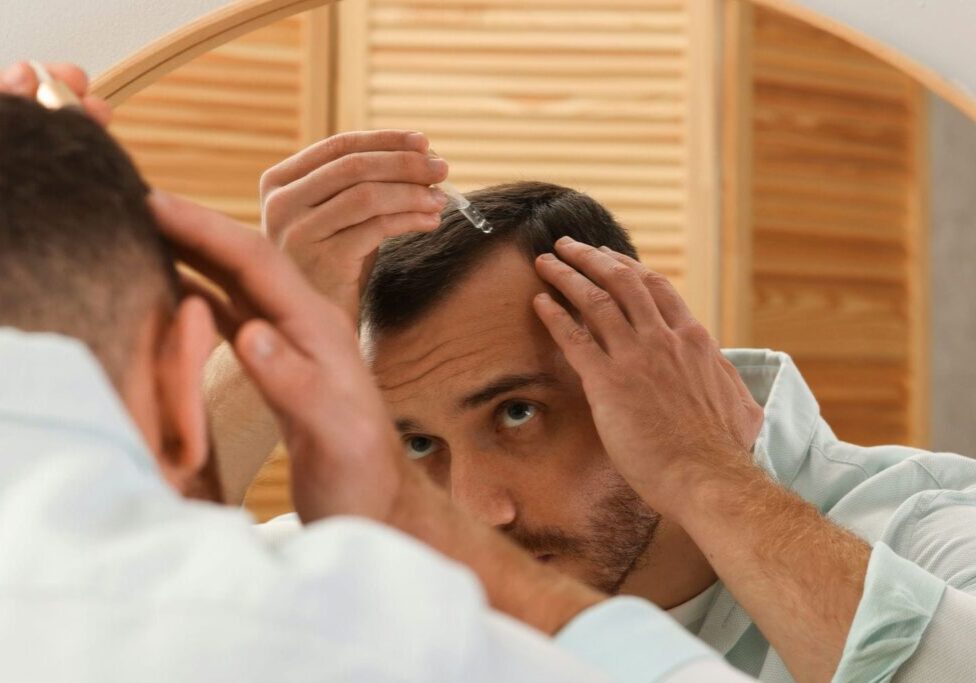
If you’ve researched treatments for male pattern hair loss, you’ve probably encountered two familiar names: minoxidil and finasteride.
Both have been studied extensively, but they don’t do the same job.
That’s exactly why researchers have become interested in using them together.
Rather than simply adding two hair-growth ingredients into the same routine, combination therapy attempts to target androgenetic alopecia through two different biological pathways.
So, is there evidence that the combination actually works better?
Let’s look at the science.
Why Combine Minoxidil and Finasteride?
Androgenetic alopecia—commonly called male pattern hair loss—is strongly influenced by genetics and dihydrotestosterone (DHT).
In genetically susceptible hair follicles, DHT gradually contributes to follicular miniaturization. In simple terms, the follicle becomes smaller and produces progressively finer and shorter hairs.
Finasteride targets this process.
It inhibits 5-alpha reductase, an enzyme responsible for converting testosterone into DHT. By reducing DHT, finasteride helps address one of the underlying hormonal drivers of male pattern hair loss.
Minoxidil works differently.
Its exact mechanism in hair growth is complex, but minoxidil helps support the hair-growth cycle and prolong the anagen, or active growth phase, of the hair follicle.
Think of it this way:
Finasteride helps reduce the signal contributing to follicle miniaturization, while minoxidil helps encourage the follicle to remain in its growth phase.
Because they target different pathways, researchers have investigated whether using them together can produce better results than either treatment alone.
What Does the Clinical Evidence Show?
So, does combining topical minoxidil and finasteride actually work better?
The evidence so far is promising.
A 2024 randomized, single-blind study followed 164 men with androgenetic alopecia who were treated with either topical finasteride 0.25% combined with minoxidil 5% or topical minoxidil 5% alone.
After 12 weeks, the researchers reported treatment efficacy in 86.7% of men using the combination compared with 69.1% using minoxidil alone, a statistically significant difference.
Larger analyses point in a similar direction. A 2025 systematic review and meta-analysis combined seven randomized controlled trials involving 396 men. Overall, topical minoxidil-finasteride combinations were associated with greater improvements in hair density, hair diameter, and photographic assessments compared with topical minoxidil alone.
Across these studies, researchers evaluated different formulations, generally containing approximately 3–5% minoxidil with 0.1–0.25% finasteride.
The takeaway? Using minoxidil and finasteride together may provide additional benefit because they target hair loss through different pathways. However, the studies vary in formulation, concentration, and treatment duration, and many remain relatively small. The evidence is encouraging, but larger and longer-term studies are still needed before we can determine the ideal combination or concentration.
Why Might a Topical Combination Be Appealing?
One practical advantage of topical therapy is the ability to deliver medication directly to the scalp.
Topical finasteride was developed partly to reduce systemic exposure compared with oral finasteride.
In a large Phase III trial involving 458 men, topical finasteride significantly improved hair count compared with placebo. Importantly, maximum plasma finasteride concentrations were more than 100 times lower with topical than oral finasteride, while serum DHT decreased by approximately 35% with topical treatment versus 56% with oral treatment.
That brings us to an important point.
Topical Finasteride Does Not Mean Risk-Free
Topical does not mean completely local.
Although systemic exposure is substantially lower than with oral finasteride, some finasteride can still enter the bloodstream, and clinical studies have demonstrated measurable reductions in serum DHT with topical treatment.
Finasteride also requires particular caution around pregnancy and people of child-bearing potential because exposure during pregnancy may interfere with normal development of the external genitalia of a male fetus. Women who are pregnant or may become pregnant are advised not to use finasteride and to avoid direct exposure to the active medication.
Precautions also matter when men use topical finasteride, especially if they have a pregnant partner or someone of child-bearing potential in the household. Unlike an intact coated tablet, a topical preparation is deliberately placed on the scalp and can potentially remain on the skin or be transferred before it has dried.
Patients should follow their prescriber’s and pharmacist’s instructions regarding application, hand washing, storage, avoiding unintended skin-to-skin transfer, and pregnancy precautions.
Topical finasteride may reduce systemic exposure, but it should still be treated as a prescription medication—not simply as a cosmetic hair serum.
The Practical Takeaway
Minoxidil and finasteride make an interesting combination because they approach androgenetic alopecia from different directions.
Current clinical evidence suggests that topical minoxidil combined with topical finasteride may provide greater improvement than minoxidil alone in some men. However, many studies remain relatively small and short in duration, and larger long-term trials are still needed.
For patients interested in individualized treatment, a physician can assess whether minoxidil, finasteride, a combination of the two, or another approach is appropriate based on their medical history and hair-loss pattern.
References
- Asad N, Naseer M, Ghafoor R. Efficacy of Topical Finasteride 0.25% With Minoxidil 5% Versus Topical Minoxidil 5% Alone in Treatment of Male Pattern Androgenic Alopecia. Journal of Drugs in Dermatology. 2024;23(11):1003–1008. doi:10.36849/JDD.7826. https://pubmed.ncbi.nlm.nih.gov/39496123/
- Li Y, He Q. Comparing minoxidil-finasteride mixed solution with minoxidil solution alone for male androgenetic alopecia: a systematic review and meta-analysis of randomized controlled trials. Frontiers in Medicine. 2025. https://pmc.ncbi.nlm.nih.gov/articles/PMC12537375/
- Johnson H, Huang D, Clift AK, et al. Effectiveness of Combined Oral Minoxidil and Finasteride in Male Androgenetic Alopecia: A Retrospective Service Evaluation. Cureus. 2025;17(1). https://pubmed.ncbi.nlm.nih.gov/39958004/
- Piraccini BM, Blume-Peytavi U, Scarci F, et al. Efficacy and safety of topical finasteride spray solution for male androgenetic alopecia: a phase III, randomized, controlled clinical trial. Journal of the European Academy of Dermatology and Venereology. 2022;36(2):286–294. https://pubmed.ncbi.nlm.nih.gov/34634163/